



EU Health Data API
1.0.0-ballot - ballot
150
EU Health Data API
1.0.0-ballot - ballot
150
This page is part of the EU Health Data API (v1.0.0-ballot: STU1 Ballot 1) based on FHIR (HL7® FHIR® Standard) R4. This is the current published version in its permanent home (it will always be available at this URL). For a full list of available versions, see the Directory of published versions
This Implementation Guide addresses technical requirements from the European Health Data Space (EHDS) regulation, specifically focusing on the interoperability requirements placed on EHR systems.
The regulatory basis is primarily found in EHDS ANNEX II - Essential Requirements for EHR Systems (EUR-Lex, Local Copy), which describes an obligation for EHR systems to include an Interoperability Component that does the following:
Note that this IG does NOT create legal obligations on EHR Systems unless adopted by the European Commission.
This IG inherits and builds upon the work of the Xt-EHR Joint Action, which has created deliverables drafting the EHDS Implementing Acts. Two deliverables are central: D5.1 defines exchange requirements — how data flows between systems — and D8.1 defines the data model and conformance framework — what conformant data looks like. This IG implements D5.1 as FHIR actors and transactions for exchange, and references D8.1 content profiles carried by those exchanges.
These requirements have also been adjusted to harmonize with Xt-EHR Work Packages 6 and 7, which define requirements for each priority category.
For more details on the Xt-EHR work, see the Xt-EHR Website. Note: Xt-EHR deliverables are not yet publicly released.
The EHDS regulation defines the interoperability component at a high level, but interoperability needs to be defined with technical precision in order for two systems to effectively achieve interoperability.
This table describes the bridge between the regulation text and precise and implementable specifications.
| Layer | EHDS Regulation | EHR Functional Requirements | Technical Specifications (You Are Here) |
|---|---|---|---|
| Description | Law. High-level description of interoperability goals. | EHDS Implementing acts. System roles and capabilities, requirements on EHR systems to achieve those goals |
Strictly defined interoperability technical rules. Implementable Guide describing use FHIR (or other) specifications. Basis of interoperability conformance |
| Level of Technical Detail | low | medium | high |
| Example | EHDS Annex § 2.1: The EHR system should provide access to data in the EEHRxF format | api-access-doc: The EHR system Interoperability Software Component SHALL offer an API that enables an external system (such as a consumer) to access and retrieve its priority category data, for categories where that data is modeled as a FHIR Document |
The api-access-doc requirement is met by the EHR System implementing the IHE MHD ITI-67 and ITI-68 transactions as the Document Responder actor. Example FHIR Query: GET [base]/DocumentReference?category=123 |
| Owner | European Commission | European Commission (drafted by Xt-EHR), Member States |
To be decided by the European Commission and Member States. SDOs (HL7 EU, IHE Europe) are proposing a draft with this Implementation Guide |
Legal authority flows from left to right on this diagram. Self-testing of an EHR system in the EHDS Digital Testing Environment is best enabled by the right-most technical specification layer.
The Xt-EHR Work Packages, notably WP 5.1, have drafted the middle layer: EHR Functional Requirements.
We inherit and evolve that work, focusing on the technical specification layer of these interoperability requirements, using off the shelf IHE and HL7 standards. The requirements themselves and how they are applied to EHR products are not defined in this IG. These are ultimately owned by the European Commission to be finalized in the EHDS Implementing Acts.
D5.1 defined 26 requirements across three categories (see Xt-EHR D5.1 Annex for complete list):
Xt-EHR Deliverable 5.1 interpreted 2.1 and 2.2 as two sides of a query-based architecture:
| Regulation | D5.1 Interpretation | IG Actor |
|---|---|---|
| §2.1 "provide interface enabling access" | Producer: Serve queries for EEHRxF data | Access Provider |
| §2.2 "be able to receive" | Consumer: Initiate queries and receive responses | Consumer |
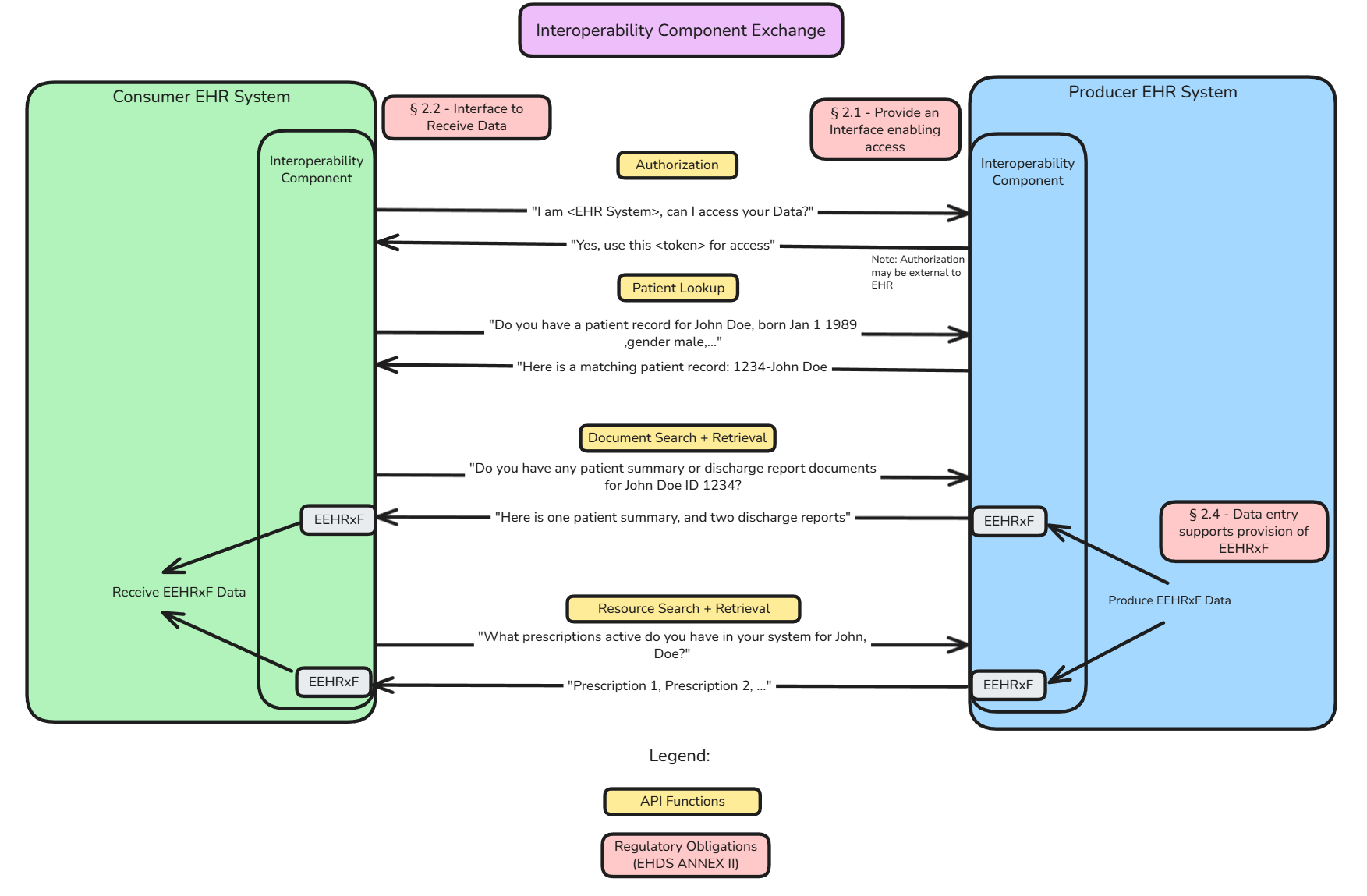
This interpretation is grounded in the following rationale:
The Access Provider actors (Document Access Provider, Resource Access Provider) satisfy §2.1 by serving Document and Resource FHIR queries.
Alternatively, this IG proposes a path for EHR systems to delegate their §2.1 obligations to another system.
The EHR system implements the Document Publisher role, publishing data to an Access Provider that serves queries on its behalf.
This pathway addresses real-world deployment scenarios:
See Actors for complete definitions and Example Groupings for deployment illustrations.
The Consumer actors (Document Consumer, Resource Consumer) satisfy §2.2 by initiating Document and Resource queries to retrieve and receive data from Access Providers.
Systems that need to accept documents pushed from Publishers (e.g., national infrastructure, regional repositories, integration engines) may implement the Document Submission Option on the Document Access Provider actor. This is an additional capability for systems acting as aggregation points—it is not required to satisfy §2.2.
The following table maps each D5.1 interoperability requirement to its implementation in this IG:
Terminology note: D5.1 uses "Producer" to describe the system serving the query API. This IG uses "Access Provider" to make the API-serving role explicit and avoid confusion with content creation.
| D5.1 Req ID | D5.1 Normative Requirement | EHDS Basis | Actor | IG Section | Technical Spec |
|---|---|---|---|---|---|
api-provider-general |
The EHR system acting as a provider SHALL provide access to its priority category data by offering an API that complies to the EHDS API specification. | Annex II §2.1 | Access Provider | Document Access Provider, Resource Access Provider | This IG |
api-provider-authDiscovery |
The EHR system Interoperability Software Component SHALL enable discovery of its authorization server information to enable a consumer to retrieve authorization. | Annex II §1.4, Art. 36(3)(e) | Access Provider | Authorization - Discovery | SMART .well-known/smart-configuration, IHE IUA |
api-provider-authProvideToken |
The EHR system Interoperability Software Component SHALL support issuing authorization tokens to consumer EHR systems. | Annex II §1.4, Art. 36(3)(e) | Access Provider [1] | Get Access Token (ITI-71) | SMART Backend token endpoint, IHE IUA |
api-provider-authRequireToken |
The EHR system Interoperability Software Component SHALL require a valid authorization token from the Consumer EHR on Interoperability Component exchange. | Annex II §1.4, Art. 36(3)(e) | Access Provider | Incorporate Access Token (ITI-72) | Bearer token validation, IHE IUA |
api-provider-patient |
The EHR system Interoperability Software Component SHALL offer a patient lookup API. | Annex II §2.1 | Access Provider | Patient Demographics Supplier | PDQm ITI-78 |
api-provider-doc |
The EHR system Interoperability Software Component SHALL offer an API that enables an external system to access and retrieve its priority category data modelled as FHIR Documents. | Annex II §2.1 | Access Provider | Document Responder | MHD ITI-67, ITI-68 |
api-provider-resource |
The EHR system Interoperability Software Component SHALL offer search and read access via individual FHIR Resource API(s). | Annex II §2.1 | Access Provider | Clinical Data Source | IPA Server/QEDm |
[1] Note on Authorization Server: The EHR system may or may not be bundled with its own authorization server. See Authorization Server Deployment for details.
| D5.1 Req ID | D5.1 Normative Requirement | EHDS Basis | Actor | IG Section | Technical Spec |
|---|---|---|---|---|---|
api-consumer-general |
The EHR system Interoperability Software Component acting as a consumer SHALL consume external priority category data via an API conforming to the EHDS API specification. | Annex II §2.2 | Consumer | Document Consumer, Resource Consumer | This IG |
api-consumer-authObtainToken |
The EHR system Interoperability Software Component SHALL obtain an authorization token from the provider's designated authorization server. | Annex II §1.4, Art. 36(3)(e) | Consumer | Get Access Token (ITI-71) | SMART Backend client credentials grant, IHE IUA |
api-consumer-authPresentToken |
The EHR system Interoperability Software Component SHALL present a valid token to the Provider EHR on Interoperability Component Exchange. | Annex II §1.4, Art. 36(3)(e) | Consumer | Incorporate Access Token (ITI-72) | Bearer token in Authorization header |
api-consumer-patient |
The EHR system Interoperability Software Component SHALL support an external patient lookup query API. | Annex II §2.2 | Consumer | Patient Demographics Consumer | PDQm Consumer |
api-consumer-doc |
The EHR system Interoperability Software Component SHALL support an external document query API. | Annex II §2.2 | Consumer | Document Consumer | MHD Document Consumer |
api-consumer-resource |
The EHR system Interoperability Software Component SHALL support an external resource query API. | Annex II §2.2 | Consumer | Clinical Data Consumer | IPA Client/QEDm |
These requirements apply regardless of which pathway is used to provide or receive data. The content must be valid EEHRxF whether served directly by an Access Provider or published via ITI-105.
| D5.1 Req ID | D5.1 Normative Requirement | EHDS Basis | Actor | IG Section | Technical Spec |
|---|---|---|---|---|---|
api-producer-data |
The EHR system SHALL be capable of providing priority category data that conforms to the EEHRxF data format. | Annex II 2.1, 2.1, | Any system providing data | Priority Category Content Profiles | HL7 EU Content IGs |
api-consumer-data |
The EHR system SHALL be able to receive and handle data conforming to the EEHRxF data format. | Annex II §2.2 | Any system receiving data | Priority Category Content Profiles | HL7 EU Content IGs |
| D5.1 Req ID | D5.1 Normative Requirement | EHDS Basis | Actor | IG Section | Technical Spec |
|---|---|---|---|---|---|
api-encryption |
The EHR system Interoperability Component SHALL be capable of transport-encrypted data exchange. | Annex II §1.4, Art. 36(3)(e) | All | Transport Security | TLS 1.2+ |
The preceding sections describe how this IG implements D5.1's exchange requirements. This section describes the relationship to D8.1, which defines the data model and conformance framework for the content that flows through those exchanges.
D8.1 defines what conformant health data looks like: the fields a Patient Summary must contain, the obligations on systems that create or consume that data, and the scope of conformance a system can claim. This IG implements D5.1's exchange requirements as FHIR actors and transactions. The Content IGs implement D8.1's data requirements as FHIR profiles. Together, they provide a complete interoperability specification.
Note: D8.1 is an in-progress Xt-EHR deliverable, not yet publicly released. This section summarizes the concepts this IG builds upon.
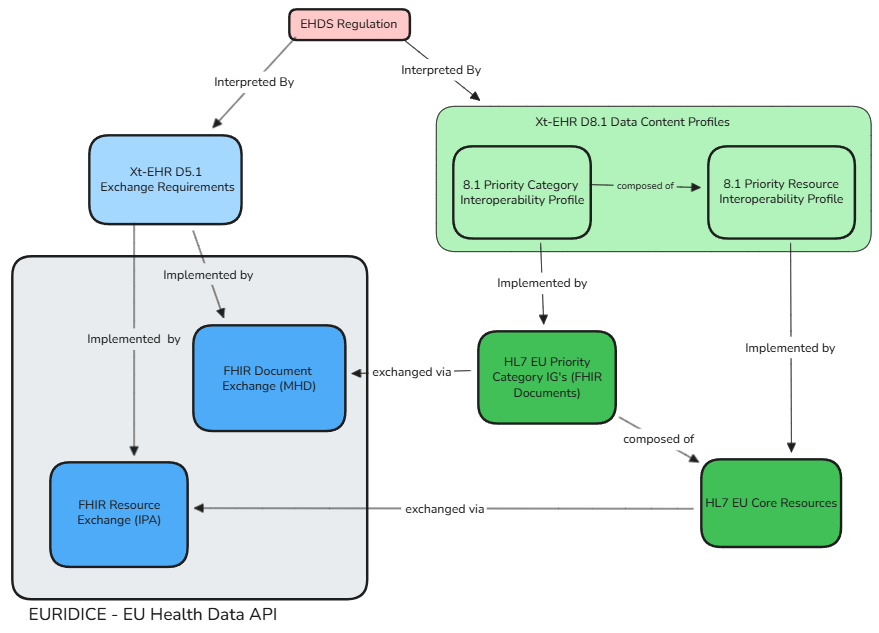
D8.1 defines two types of Interoperability Profile that a system can claim conformance to:
Priority Interoperability Profiles apply to systems that produce or consume a complete priority dataset — a Patient Summary, a Discharge Report, a Laboratory Report, an Imaging Report, an ePrescription, or an eDispensation. Patient Summary, Discharge Report, Laboratory Report, and Imaging Report are structured as FHIR Documents.
Resource Interoperability Profiles apply to systems that support individual clinical resources — allergies, conditions, immunizations, medications, observations, and others — without producing or consuming complete priority datasets. D8.1 calls this scoped conformance: a system is assessed only for the resources it claims to support.
These are separate conformance paths. A vaccination registry that serves Immunization resources claims conformance to the Immunization Resource Interoperability Profile. A hospital EHR that produces full Patient Summaries claims conformance to the Patient Summary Priority Interoperability Profile. Both are valid under D8.1.
D8.1 defines content: data structure and obligations. D8.1's Producer and Consumer roles describe content creation and consumption — a Producer populates conformant data; a Consumer processes received data. The Content IGs fulfill these obligations as FHIR profiles.
D5.1 defines exchange: how conformant data moves between systems via APIs. This IG implements D5.1 as FHIR actors and transactions (see Xt-EHR Deliverable 5.1 above).
Neither deliverable states which exchange pattern serves which content profile type. This IG bridges that gap: Priority Categories maps each priority category to its content specification and exchange pattern. A conformant implementation combines both — for example, the Retrieve a Patient Summary use case requires the EU Patient Summary IG for content and this IG's document exchange for transport.
For medication data, this IG covers reading MedicationRequest and MedicationStatement as individual resources via resource exchange. The ePrescription and eDispensation workflow transactions (prescribing, dispensing) are out of scope and handled by IHE MPD.
D8.1 specifies that when a Priority Interoperability Profile references another profile (e.g., a Patient Summary references the EHDS Patient profile), the referenced profile's data obligations also apply. This is a data model requirement: the Patient resource inside a Patient Summary must conform to the EHDS Patient profile. It does not by itself mandate independent resource-level exchange for that resource. Data model conformance is the Content IGs' domain; exchange is this IG's domain, based on the system's declared conformance path.
IG © 2025+ HL7 Europe.
Package hl7.fhir.eu.health-data-api#1.0.0-ballot based on FHIR 4.0.1.
Generated
2026-03-13

